
 Knowledge Panel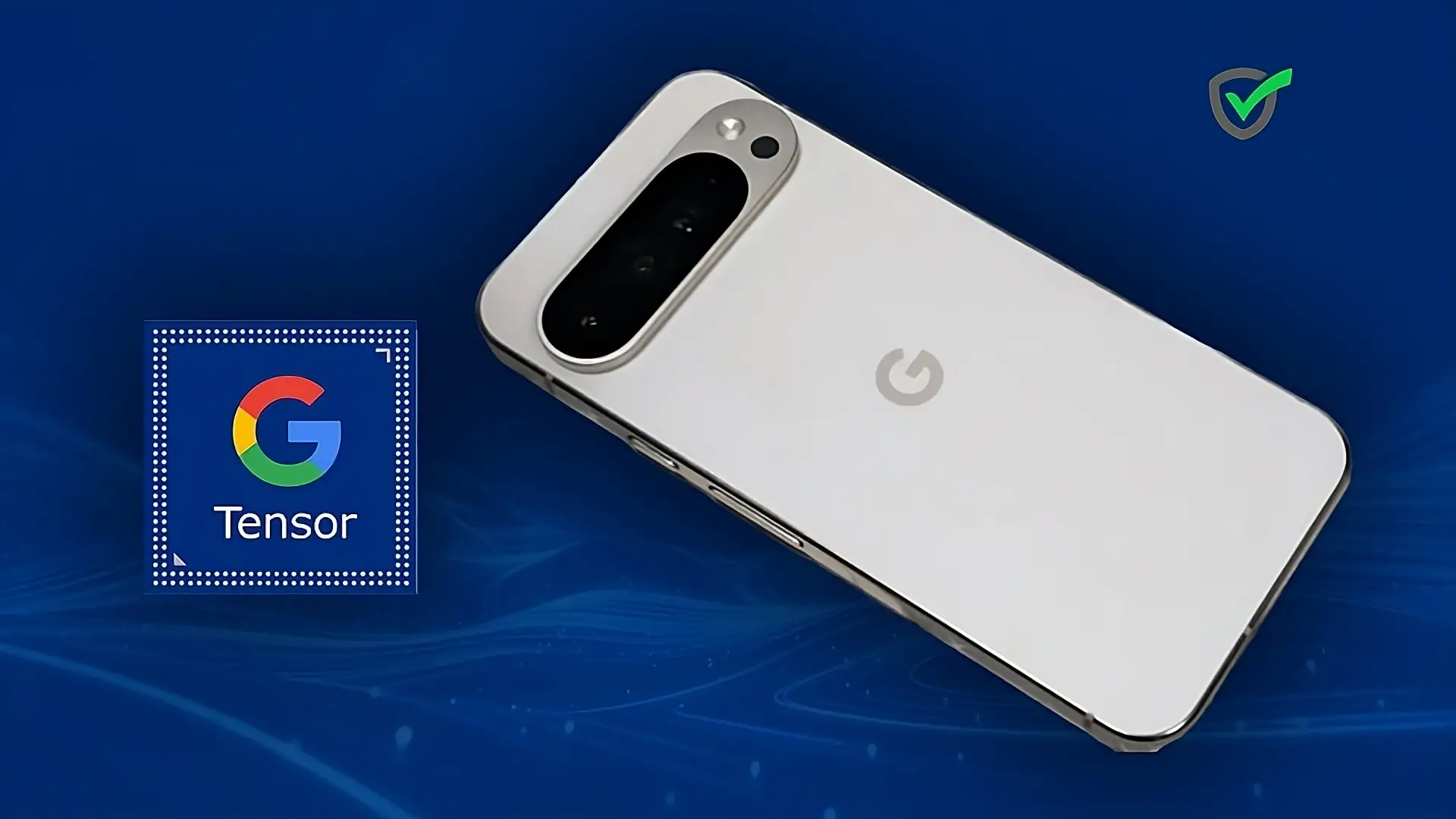
The Unseen Architect: Unlocking the Hidden Powers of Pixel 10's Tensor G5/G6 🧠✨
As someone who navigates the intricate layers of both web development and cybersecurity, I'm constantly fascinated by the silent powerhouses that drive our digital lives. In the smartphone arena, while flashy features grab headlines, the true magic often lies beneath the surface, within the silicon that orchestrates every tap, swipe, and AI-driven insight. For Google's upcoming Pixel 10, that unseen architect is the next-generation Tensor chip – the Tensor G5, with glimpses of the future G6.
This isn't just another mobile processor; it's the culmination of Google's ambitious vertical integration strategy, a bespoke brain designed to unlock capabilities that off-the-shelf chips simply can't match. Forget raw benchmark numbers for a moment; the real story of Tensor G5/G6 is about intelligent efficiency, seamless integration, and a profound shift towards on-device AI that redefines the smartphone experience.
The AI Maestro: On-Device Intelligence Redefined 🤖💡
Google's Tensor chips have always prioritized Artificial Intelligence and Machine Learning (AI/ML), and the G5/G6 are set to elevate this to an unprecedented level. The core of this prowess lies in the Tensor Processing Unit (TPU), Google's custom-designed AI accelerator. The Tensor G5 is expected to feature a next-gen EdgeTPU, offering a significant 40% increase in Trillions of Operations Per Second (TOPS) compared to its predecessor, the Tensor G4. [1] This isn't just about speed; it's about enabling complex AI tasks to run entirely on your device, quickly and privately, without constant reliance on cloud processing.
This on-device AI acceleration translates directly into a more intuitive and responsive user experience:
- Smarter Google Assistant: Expect Google Assistant to become even faster and more natural, understanding complex queries and providing proactive suggestions based on your usage, location, and routines.
- Revolutionary Photography & Video: The Pixel's legendary computational photography is set for a massive leap. The Tensor G5 will enable "Video Generative ML" for intuitive, AI-based video editing in the Photos app, potentially extending to YouTube Shorts. Imagine using "Speak-to-Tweak" to edit photos with voice commands or "Sketch-to-Image" to transform your doodles into realistic additions. The Tensor G6, looking further ahead, is rumored to bring "Ultra Low Light video" that processes entirely on-device (no cloud needed for Night Sight video) and "Cinematic Blur with lighting controls," offering advanced video manipulation with significant power efficiency gains. The G6 is also anticipated to power a machine learning-enhanced 100x zoom for photos and videos.
- Smarter App Performance: Beyond Google's own apps, the enhanced TPU will accelerate general app performance, making everything feel snappier.
- Advanced Personal Safety & Communication: Features like smarter spam call blocking and voice replies are expected to become even more robust. [1] The G6's new nanoTPU is particularly intriguing, designed for lower-power, always-on machine learning tasks, enabling background health features like breathing, cough, fall detection, and sleep stage monitoring, marking a more holistic approach to on-device health data processing.
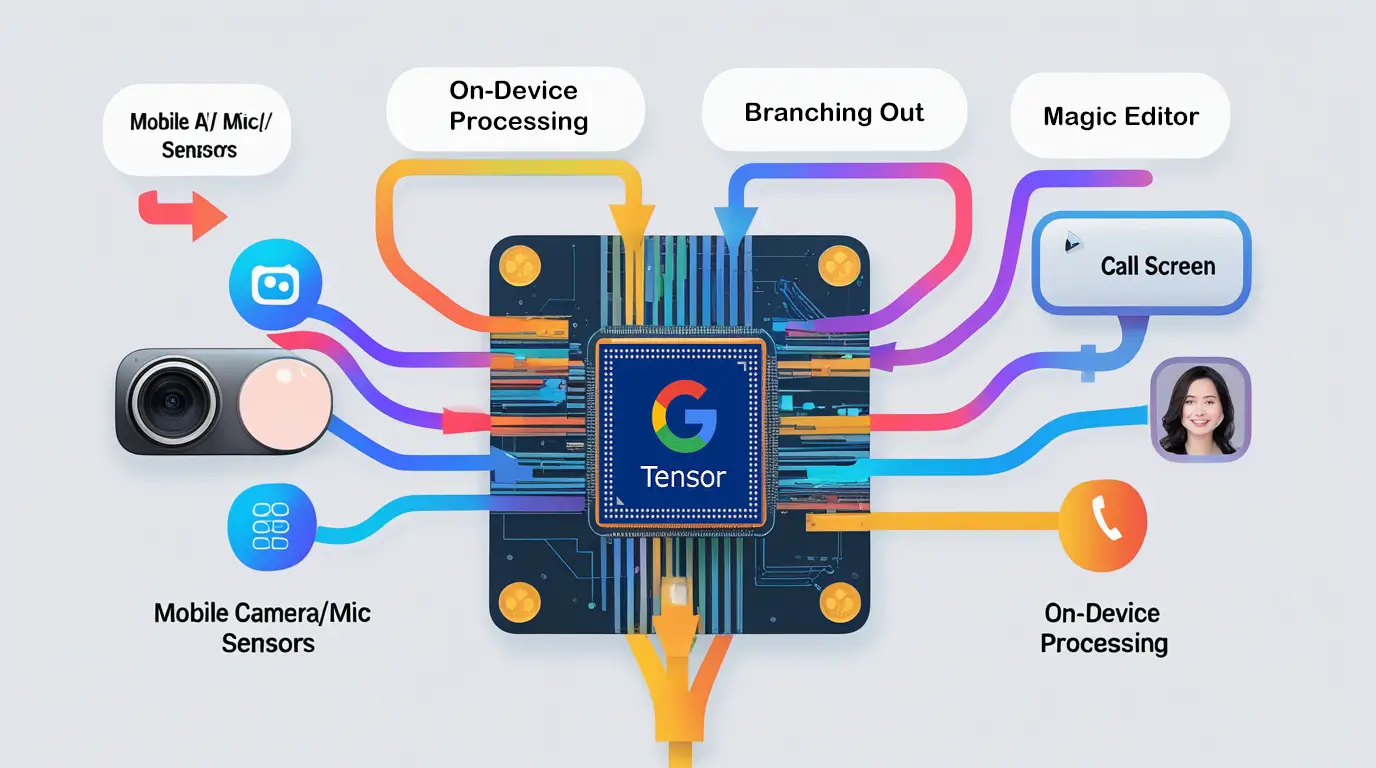
A dynamic infographic showing data flowing from camera/mic/sensors into a stylized Tensor chip, with different AI features (e.g., "Magic Editor," "Call Screen") branching out, emphasizing "On-Device Processing. [1]
Raw Power & Gaming Prowess: A New Era of Performance 🚀🎮
While Tensor has historically focused on AI, the G5 marks a significant shift in its raw processing capabilities. For the first time, Google is moving away from Samsung's manufacturing to TSMC's advanced 3nm N3E process. This is a game-changer, promising enhanced performance, reduced power consumption, and significantly improved thermal efficiency.
- CPU Advancements: The Tensor G5 features an 8-core CPU, including a Cortex-X4 prime core, five Cortex-A725 performance cores, and two Cortex-A520 efficiency cores. [1] While some reports suggest a modest leap in peak performance compared to rivals, the focus is on sustained performance and efficiency, crucial for real-world usage.
- GPU Overhaul for Gaming: Google is making a significant switch from ARM Mali GPUs to Imagination Technologies' IMG DXT GPU. This new GPU supports Level 4 ray tracing, the highest level in the Ray Tracing Level System, promising more realistic and immersive gaming experiences with improved power efficiency. This move aims to address past criticisms of Tensor's gaming performance and deliver smoother, more consistent frame rates.
- Thermal Management: The shift to TSMC's 3nm process and Google's use of InFO-POP chip packaging are expected to significantly improve heat management, allowing the Tensor G5 to maintain peak performance for longer without throttling.

A split screen showing a high-fidelity mobile game running smoothly on one side, and a thermal map of the phone on the other, indicating efficient heat dissipation.
Efficiency and Endurance: A Battery Life Boost 🔋⚡
One of the most anticipated benefits of the Tensor G5/G6 is a noticeable improvement in battery life. The move to TSMC's 3nm process inherently leads to lower power consumption due to increased transistor density and smaller size.
- GPU Efficiency: The new IMG DXT GPU is specifically designed for better energy efficiency compared to its Mali predecessors, which will be particularly noticeable during graphics-intensive tasks like gaming and video editing.
- Custom Components: Google's custom memory controller and system-level cache system are designed to minimize latency in data processing, making applications run faster and more responsively while optimizing power usage. The Tensor G6's Cinematic Rendering Engine, for example, is designed to reduce power consumption by 40% during video recording with blur effects.
- Holistic Optimization: These architectural changes, combined with a rumored 5,000mAh battery in the Pixel 10, are expected to deliver meaningful real-world gains in battery life, ensuring Google's promise of "all-day battery life" holds true.
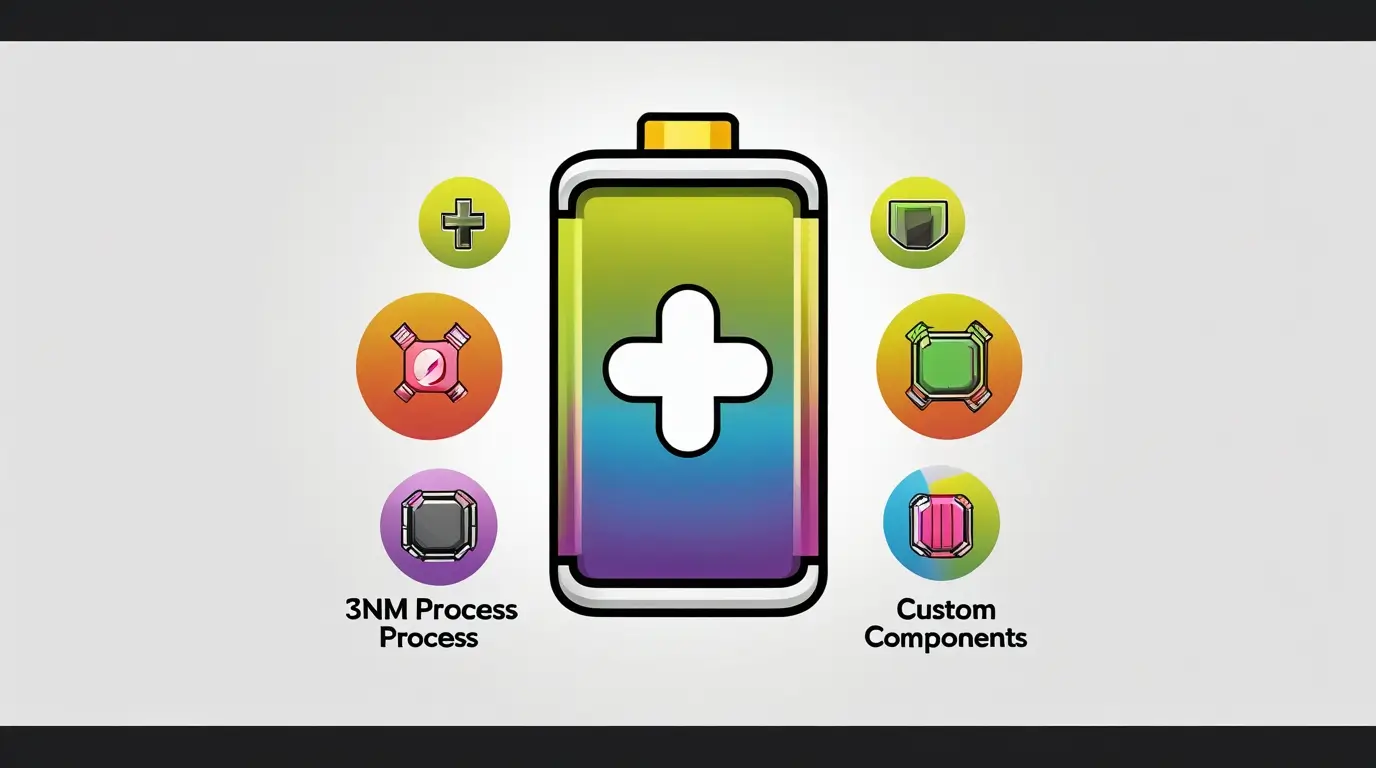
3nm process, new GPU, and custom components, all contributing to extended battery life
The Vertical Integration Advantage: Google's Unmatched Edge 🔗🔮
Google's most significant advantage with Tensor is its vertical integration – controlling every layer of the AI stack, from custom silicon to software and applications. This end-to-end ownership allows for optimizations that are simply not possible for companies relying on third-party chip vendors.
- Hardware-Software Co-design: By designing the hardware and software in tandem, Google can achieve significant performance gains. This includes tailoring instructions for specific AI workloads, optimizing memory access, and integrating specialized accelerators directly into the chip. This tight integration is why Pixel phones can perform complex AI tasks like real-time translation and advanced photo editing on-device, quickly and privately.
- End-to-End Optimization: This holistic approach results in reduced latency, improved efficiency, and better resource utilization across the entire system. Features like Call Screen, which filters spam calls using on-device AI, demonstrate this seamless integration, ensuring your conversations and summaries are never sent to the cloud.
- Accelerated Innovation: Google's control over hardware design allows for rapid iteration and improvement, bringing new AI advancements to market faster than competitors. This is evident in the continuous evolution of Tensor chips and the rapid deployment of new Pixel-exclusive features.
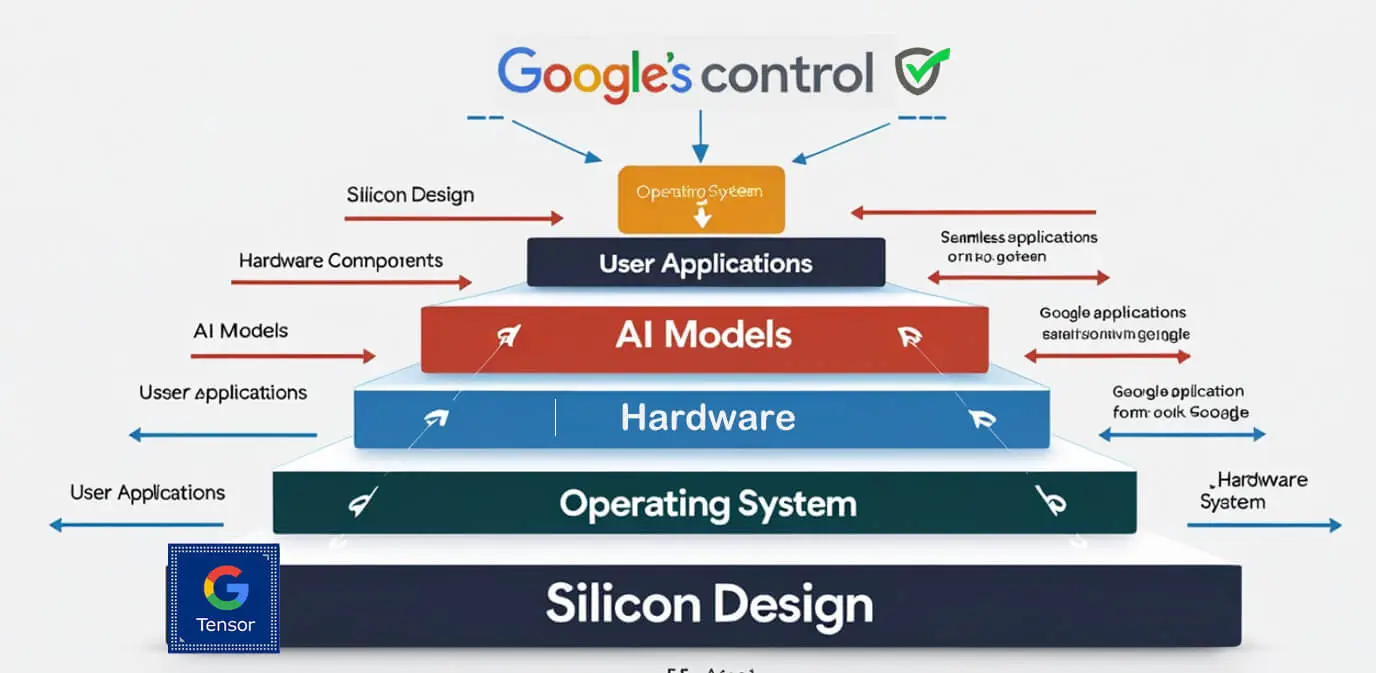
A layered diagram showing Google's control from "Silicon Design", through "Hardware Components," "Operating System," "AI Models," to "User Applications" with seamless optimization across layers
Conclusion: The Intelligent Future of Mobile 🌟📱
The Tensor G5/G6 chips are more than just processors; they are the embodiment of Google's vision for the future of mobile computing. By focusing on deep vertical integration, on-device AI, and intelligent efficiency, Google is not just competing on raw benchmarks but redefining what a smartphone can do in the real world.
The Pixel 10, powered by the Tensor G5, will offer a more personal, intuitive, and secure experience than ever before. From lightning-fast AI features that enhance your daily interactions to a gaming experience that truly shines, and a battery that keeps pace with your demands, the Tensor G5 is set to be the unseen architect of a profoundly smarter smartphone. And with the Tensor G6 already on the horizon, Google's commitment to pushing the boundaries of on-device AI and integrated performance shows no signs of slowing down. The hidden powers of Tensor are about to become very visible indeed.
Citation-1
[1]K. Mukhtar, “Pixel 10 Deep Research Paper By Kashif Mukhtar”. Zenodo, Jun. 18, 2025. doi: 10.5281/zenodo.15693650.