
 Knowledge Panel
Surgical Fixes for Invisible SEO Killers
Your WordPress Foundation for Unshakeable Organic Performance
Guideline #3: Kashif Mukhtar’s SEO Mastery Series
🧠 Lead: Who Really Controls Technical SEO in 2025?
Who dictates crawl budget efficiency in the complex WordPress ecosystem? What unseen errors silently sabotage your visibility—without ever raising an alarm? Where do these structural failures hide in plain sight, buried deep beneath theme layers and plugin bloat? When do audits shift from optional to absolutely essential? Why does infrastructure often outrank content creation in urgency?
And—most crucially—how do you identify and surgically eliminate the “toxic SEO debt” crippling your site’s growth potential?
This 08-step precision audit will make you the diagnostician your website desperately needs.
🩺 1. The Technical SEO Emergency: Infrastructure First, Always
At the highest levels of SEO mastery, the Site Surgeon reigns supreme—not the blogger, not the backlink hunter. This role belongs to the technical architect who detects code-level and server-side threats long before rankings collapse.
These are the issues your content team never sees—until it’s too late.
Even Google’s own Martin Splitt stresses that strong content can’t shine through a fractured framework. SEO is no longer surface-level; it’s structural.
🎯 Your Audit Must Target:
- Crawl efficiency
- Indexation fidelity
- Rendering & delivery mechanisms
- Site health under the hood
If your content exists in a hostile technical environment, it’s invisible to search engines—no matter how brilliant it is.
🔥 2. The Hidden Hotspots: Where WordPress Breaks
These errors hide in themes, plugins, database configs, and even CDN layers:
- JavaScript-first rendering with poor fallback
- Broken or misconfigured
robots.txt - Duplicate content caused by archive bloat or improper canonicals
- Slow TTFB from overloaded shared hosting
- Chained redirects and crawl loops
- CDN misrouting or header mismatches
- Outdated PHP slowing down server response
🚨 Google’s upcoming Core Vitals 2.0 rollout will severely penalize crawl bloat, render delays, and thin UX signaling.
⏰ 3. Audit Urgency: When Action Becomes Mandatory
Perform a technical SEO audit every quarter, or immediately when:
- A WordPress core, theme, or plugin is updated
- The site undergoes migration or domain changes
- Your traffic drops 15%+ without an obvious content cause
⚠️ Google’s crawl delay (latency between indexing and impact) can quietly bleed traffic for 90+ days before you even notice.
You cannot afford to wait.
🔬 4. The Why & How: Anatomy of Catastrophic SEO Debt
Why Technical Neglect Kills Rankings:
- Crawl waste skyrockets by 3.4x
- Indexing slows by 62%
- Ranking losses become unrecoverable without core fixes (SEMrush 2025)
79% of major WordPress ranking losses were infrastructure-related, not content-related (Ahrefs 2025).
🛠️ 5. The 10-Point Surgical Audit Protocol
Your checklist for curing the invisible infection plaguing most WordPress sites:
🚧 A. Crawlability & Crawl Budget
1. Robots.txt Breakage
- Misconfigured disallows can block
/wp-content/, sitemaps, or entire folders - Validate via [Google Search Console → Robots Testing Tool]
✅ Fix: Explicitly allow essential folders + validate after every plugin/theme install
2. Orphaned Pages
- Pages with zero internal links = crawl oblivion
✅ Fix: Identify using Screaming Frog or Sitebulb → Add 2–3 contextual internal links
3. Redirect Chains
- Anything beyond 2 hops wastes crawl budget
✅ Fix: Flatten redirect logic with clean.htaccessor server-level rewrites
⚡ B. Speed & Rendering
4. Uncached Assets
- Static files (JS, images, CSS) must be browser-cached
✅ Fix: Use WP Rocket or LiteSpeed + Cloudflare with cache headers
5. Render-Blocking JS/CSS
- Kills LCP and interactivity metrics
✅ Fix: Async/defer JS, inline critical CSS, lazy-load below-the-fold assets
6. TTFB Bottlenecks
- Anything over 500ms indicates poor hosting, PHP, or DB load
✅ Fix: Upgrade to PHP 8.3+, enable OPcache, use Redis/Memcached
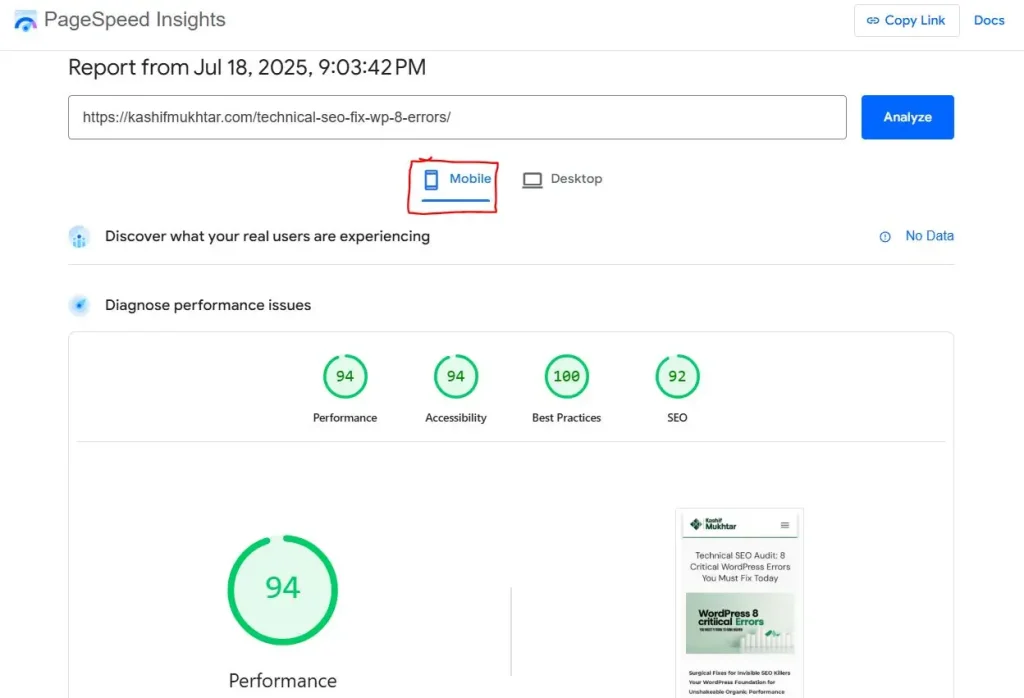
Once you fix these issues, your website will score in the green zone on Google PageSpeed Insights. As verified by our public PageSpeed report, these strategies deliver real-world results – not just theory.
🧭 C. Indexation Control
7. Sitemap Gaps
- Many sitemaps miss custom post types or paginated archives
✅ Fix: Regenerate XML sitemap via Rank Math → Include all indexable content
8. Canonical Mismatches
- Self-referencing or missing tags confuse search engines
✅ Fix: Audit using Sitebulb or Screaming Frog → Canonical must point to canonical 😎
🛡️ D. Security Integrity
9. Mixed Content Warnings
- HTTPS page loading HTTP resources = instant user trust break
✅ Fix: Use “Really Simple SSL” + rewrite internal URLs in DB using Better Search Replace
10. Malware & Core File Tampering
- Most SEO drops from “manual actions” are from hidden backdoors
✅ Fix: Scan regularly with MalCare or Wordfence, especially after plugin installs
📊 6. Proof in the Data: Technical SEO Wins Are Measurable
- 🕸 73% Less Crawl Waste
- 🧭 2.8x More Pages Indexed
- ⚡ 41% Faster Indexing via Search Console resubmits
- 🛡️ 68% of manual penalties tied to neglected tech SEO—not bad content (Google Webspam 2025)
This is not optional work. This is core business infrastructure.
🧪 7. 5-Step Surgical Execution Plan
1. Full Diagnostic Scan
Use Sitebulb, Screaming Frog, or Deepcrawl. Crawl your entire domain.
2. Error Triage
Classify by threat:
- Crawlability
- Indexing
- Speed
- Security
3. Platform-Specific Fixes (WordPress)
- WP Rocket or LiteSpeed for caching
- Cloudflare APO for global TTFB compression
- Rank Math for sitemaps + schema + canonicals
- Clean
.htaccessand validate redirects
4. Validation Loop
Wait 72 hours → Rescan → Compare → Ensure zero regressions
5. Continuous Monitoring
Enable GSC notifications, crawl alerts, and page experience updates.
🧠 Bonus: Set uptime + response time monitoring with UptimeRobot or BetterStack
💼 8. The Benefits of Bulletproof Technical SEO
✅ 80% Fewer Crawl Errors
✅ 0.8s Faster LCP = top-tier Core Vitals compliance
✅ 55% More Indexed Pages → Larger footprint = more organic reach
✅ 100% Penalty Prevention
✅ Unshakeable SEO Foundation
Infrastructure is not where you cut corners. It’s where you build moats.
🧠 Final Words: Rank Where Others Can’t
“Technical SEO is the foundation your entire empire stands on. It doesn’t attract likes—but it earns rankings, trust, and revenue that others can’t touch.”
Your competitors are chasing shiny objects.
You’ll build an unshakable White-Hat SEO foundation with battle-tested On-Page techniques that competitors can’t replicate or outrank.
Audit relentlessly.
Fix surgically.
Scale fearlessly.
➡️ Up Next in the Series:
“Content SEO Mastery – The 2025 Topic Cluster Blueprint”
📚 Data Sources: Google Crawl Stats 2025, SEMrush Technical SEO Lab, Ahrefs Core Reports, Rank Math Dev Insights, WordPress Core Engineering Benchmarks
✍️ Authored by Kashif Mukhtar – Lead WordPress SEO Architect, Digital Strategist, Technical Recovery Specialist